

Psychology is the study of human thought, emotion, and behavior. However, most mainstream psychology developed within a “secular” Western paradigm, rooted in materialist and reductionist assumptions about the human being. Islamic Psychology (ʿIlm al-Nafs), in contrast, emerges from a tawḥīdic worldview in which all aspects of reality are unified under the oneness of Allah. It perceives the human being not merely as a biological or cognitive entity but as a servant of Allah (ʿabd) and vicegerent (khalīfah) entrusted with a moral-spiritual mission.
This essay introduces Islamic Psychology for beginners, focusing on the six-fold model of the psyche: Qalb (heart), Nafs (self), ʿAql (intellect), Jism (body), Fitrah (primordial disposition), and Irādah (will)**. Furthermore, it incorporates the expanded Qur’anic and Sufi typologies of the seven levels of the nafs, moving beyond the basic tripartite model (ammārah, lawwāmah, muṭmaʾinnah) to include mulhamah, rāḍiyah, marḍiyyah, and ṣāfiyyah.
Defining Islamic Psychology
Islamic Psychology (Ilm al-Nafs) is not a matter of sprinkling religious language onto Western psychology. Rather, it is a distinct epistemological framework rooted in revelation (Qur’an and Sunnah), reason, and centuries of Muslim scholarship (Haque, 2004). The human psyche is understood holistically: body (jism), mind (ʿaql), heart (qalb), self (nafs), primordial disposition (fitrah), and will (irādah) form an integrated unity oriented toward Allah.
The discipline insists that true psychological health cannot be divorced from the spiritual. To “heal” the psyche is to restore harmony between these faculties under the sovereignty of Allah.
Historical Roots
Muslim scholars of the Golden Age laid much of the groundwork for Islamic Psychology:
Al-Kindī (d. 873) wrote about grief management and the healing role of music.
Al-Fārābī (d. 950) explored cognition and imagination as pathways toward human perfection.
Ibn Sīnā (d. 1037) analyzed mental disorders in Al-Qānūn fī al-Ṭibb, recognizing psychological and spiritual factors.
Al-Ghazālī (d. 1111) provided a detailed anatomy of the soul in Iḥyā Ulūm al-Dīn, linking ethics, psychology, and spirituality.
Ibn al-Qayyim (d. 1350) described the purification of the soul (tazkiyyat al-nafs) as central to well-being.
These thinkers did not compartmentalize psychology apart from theology, ethics, and medicine; rather, they saw all sciences as serving the higher goal of drawing closer to Allah.
The Six Core Concepts of the Human Psyche
Qalb (Heart)
The qalb is the spiritual center, the seat of faith, moral perception, and divine illumination. As the Prophet ﷺ said:“Truly, in the body there is a morsel of flesh; if it is sound, the whole body is sound; and if it is corrupt, the whole body is corrupt.” Truly, it is the heart.” (Ṣaḥīḥ al-Bukhārī, 52). The qalb can be purified through remembrance (dhikr) or diseased by sins and heedlessness.
Nafs (Self)
The nafs is the self or ego, constantly fluctuating between higher and lower states. Traditionally, three levels were emphasized: ammārah (commanding to evil), lawwāmah (self-reproaching), and muṭmaʾinnah (tranquil). But Qur’anic and Sufi sources describe seven stages of the nafs:
1. Nafs al-Ammārah – the commanding self, dominated by desires (Qur’an 12:53).
2. Nafs al-Lawwāmah– the blaming self, conscious of sin (Qur’an 75:2).
3. Nafs al-Mulhamah – the inspired self, beginning to receive divine guidance (Qur’an 91:8).
4. Nafs al-Muṭmaʾinnah – the tranquil self, content through remembrance (Qur’an 89:27–30).
5. Nafs al-Rāḍiyah – the content self, pleased with Allah’s decree.
6. Nafs al-Marḍiyyah – the self with which Allah is pleased.
7. Nafs al-Ṣāfiyyah – the purified, perfected self, free of blameworthy traits.
This expansion illustrates that human psychology is not static but developmental, representing a spiritual journey from base desire toward divine proximity.
Aql (Intellect)
The aql is the rational faculty, enabling discernment, reflection, and moral judgment. In Islamic thought, it is closely tied to the qalb, unlike in Western dualism that separates mind from heart. True ʿaql operates best when illuminated by revelation, rather than confined to material logic.
Jism (Body)
The jism grounds the psyche in material existence. Caring for the body is not merely medical but spiritual: proper diet, rest, and cleanliness are forms of worship. The jism also expresses the states of the psyche—stress, anxiety, or serenity manifest physiologically.
Fitrah (Primordial Nature)
Every human being is created upon fitrah, an innate disposition toward truth and tawḥīd. The Prophet ﷺ said:“Every child is born upon fitrah; then his parents make him a Jew, a Christian, or a Magian.” (Ṣaḥīḥ Muslim, 2658). Psychological dysfunction can be seen as alienation from this original purity; healing involves returning to one’s fitrah through remembrance and obedience.
Irada (Will)
The newly emphasized dimension is irada (will), the activating axis that translates knowledge and desire into action. Al-Ghazālī describes irādah as the resolve that follows knowledge—once the truth is known, the will directs the self to pursue it. Without irādah, the nafs remains stagnant, wavering between good intentions and inaction.
Irādah interacts with all other faculties:
It directs the qalb toward sincerity.
It disciplines the nafs away from hawāʾ (whim).
It harnesses the aql for righteous purposes.
It governs the jism in obedience.
It safeguards the fitrah from corruption.
Thus, irada is the decisive force of accountability—what orients the human being either toward Allah or toward heedlessness.
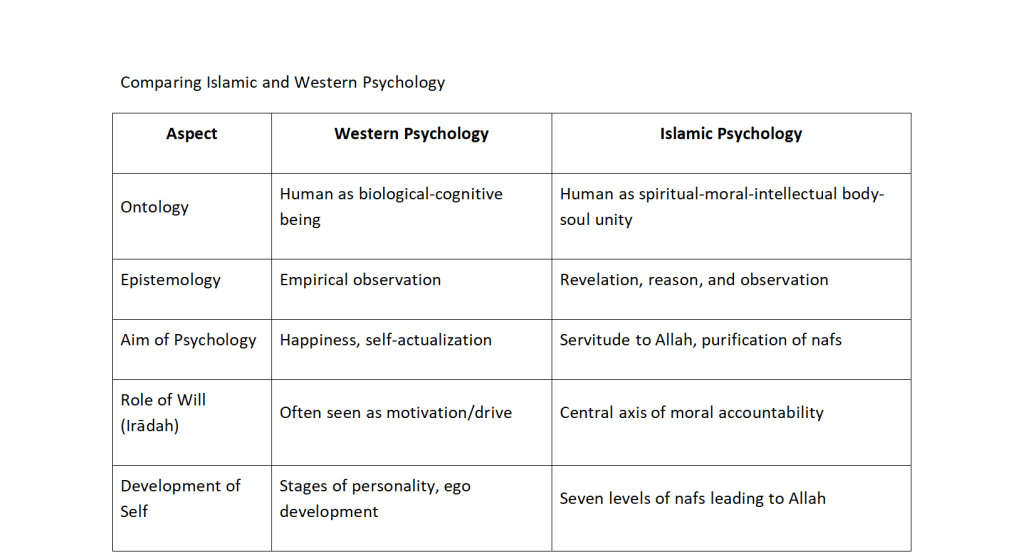
This comparison shows how Islamic Psychology reframes human flourishing beyond secular well-being, embedding it within eternal accountability.
Islamic Psychology offers not only a discipline but a transformative worldview. By recognizing the six-fold model—Qalb, Nafs, ʿAql, Jism, Fitrah, and Irādah—we see the human psyche as dynamic, accountable, and teleologically oriented toward Allah. Expanding the typology of the nafs to seven stages provides a roadmap for spiritual-psychological growth, from the base self (ammārah) to the perfected self (ṣāfiyyah).
For beginners, the study of Islamic Psychology is not an abstract academic pursuit but an existential invitation: to purify the heart, align the will, and actualize one’s fitrah in servitude to Allah.
References
[1]Abu-Raiya, H., & Pargament, K. I. (2011). Empirically based psychology of Islam: Summary and critique of the literature. *Mental Health, Religion & Culture, 14*(2), 93–115. [https://doi.org/10.1080/13674676.2010.537370](https://doi.org/10.1080/13674676.2010.537370)
[2]Badri, M. (1979). The dilemma of Muslim psychologists. London: MWH London Publishers.
[3]Deuraseh, N., & Abu Talib, M. (2005). Mental health in Islamic medical tradition. *The International Medical Journal, 4*(2), 76–79.
[4]Haque, A. (2004). Psychology from Islamic perspective: Contributions of early Muslim scholars and challenges to contemporary Muslim psychologists. Journal of Religion and Health, 43(4), 357–377. [https://doi.org/10.1007/s10943-004-4302-z](https://doi.org/10.1007/s10943-004-4302-z)
[5]Nasr, S. H. (2006). The heart of Islam: Enduring values for humanity. HarperOne.
[6]Skinner, R. (2019). An Islamic model of the self and personality: An empirical exploration. *Journal of Religion and Health, 58*(5), 1609–1624. [https://doi.org/10.1007/s10943-019-00908-2](https://doi.org/10.1007/s10943-019-00908-2)
 Unconventional Duha Research Unitary