
The concept of spiritual intelligence (SQ) has emerged as a significant field of study in contemporary psychology and philosophy, focusing on the capacity to address existential questions, derive meaning from experiences, and connect with transcendent aspects of life. While Western scholars like Gardner, Emmons, and Zohar have pioneered theories of multiple intelligences, including spiritual and existential dimensions, Islamic tradition offers a rich, holistic framework rooted in the Qur’an and Sunnah. This model design Unconvetional Duha explores Qur’anic cognitive terminologies—such as Tafakkur (deep reflection) Tadabbur (contemplation) and Tazakkur (remembrance)—within the spectrum of spiritual intelligence theory, arguing that these concepts form an integrated system that harmonizes reason, revelation, and intuition to achieve human flourishing.
Summary Table of Key Terminologies
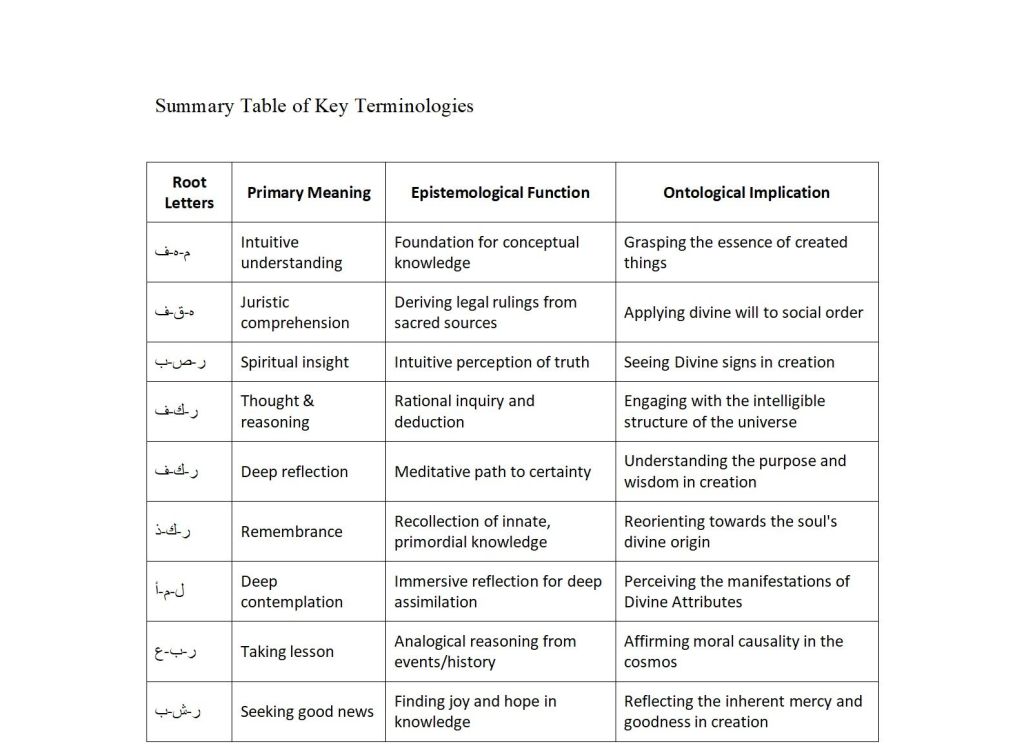
It is structured in four ascending tiers, each comprising specific heart-cognitive processes.
Tier 1: Tahsil Al Elm (Receptive Capacities)
This tier represents the initial acquisition and grasping of knowledge.
· Al-Fikr (الفِكْر): General thought and reasoning.
· Al-Taaqqul (التَّعَقُّل): The application of rational intellect to avoid blind imitation and to affirm truth through logical discernment.
· Al-Fahm (الفَهْم) / Al-Tafahhum (التَّفَهُّم): The foundational ability to intuitively understand and comprehend information. It is the prerequisite for all higher learning.
Tier 2: Tajdid Al Qulb (Active Processing, Heart- Cognitive Engagements)
This tier involves the deep, active engagement of the intellect with the acquired information.
· Al-Tafakkur (التَّفَكُّر): Deep reflection on creation to derive spiritual insights and recognize divine wisdom and purpose.
· Al-Tadabbur (التَّدَبُّر): Contemplative deliberation on the Qur’anic verses to understand their meanings, coherence, and legal/moral implications.
· Al-Ta’ammul (التَّأَمُّل): Serene, sustained meditation, allowing knowledge to be deeply assimilated beyond superficial understanding.
Tier 3: Itqan Al Ta’alum (Applied Intelligence, Practical Integration)
This tier translates processed knowledge into practical understanding and real-world application.
· Al-Fiqh (الفِقْه) / Tafaqquh (تَفَقُّه): Juristic comprehension; the ability to derive and apply ethical-legal rulings in daily life. It represents the practical dimension of understanding that guides behavior.
· Al-I’tibar (الإِعْتِبَار) / Iktibar (إِكْتِبار): The ability to learn lessons from historical events, natural patterns, and social contexts. It uses analogical reasoning to understand divine laws (sunan) in existence.
· Al-Tawassum (التَّوَصُّم): The capacity to perceive divine signs (ayat) in the cosmos, history, and the self. It is the act of “reading” the universe as a book reflection of God’s attributes.
Tier 4: Tahqeeq Al Ruhanniyah (Transcendent Realization)
This is the pinnacle of spiritual intelligence, where the mind, cognitive processes combine with the heart-intellect create transformative spiritual enlighten.
· Al-Baṣīrah (البَصِيرَة): Inner insight or spiritual vision. This is the ability to perceive the unseen realities (ghayb) behind the visible world, to discern truth from falsehood in complex matters, and to judge with divine light.
· Al-Istibshār (الإِسْتِبْشَار): Spiritual gladness and hopefulness. It is the emotional and spiritual state of finding joy, comfort, and optimism in God’s promises, mercy, and the good news found in faith.
· Al-Tazakkur (التَّذَكُّر) / Tadzakkur (التَّذَكُّر): Existential remembrance and anamnesis. It is the culmination of all previous processes, resulting in the heart’s reawakening to primordial truths, constant awareness of God (dhikr), and heeding spiritual admonitions.
The Dynamic Flow of the Model
Spiritual intelligence, in this model, is not linear but dynamic.
The outcomes in Tier 4 (e.g., Baṣīrah and Tazakkur) subsequently refine and enhance the capacities in Tier 1 (Fahm and Tawassum), creating a virtuous cycle of increasing wisdom and spiritual acuity. The entire process is fueled by the belief that all knowledge ultimately points toward and originates from the Divine (Tawhid) ad is a source of enlightment, light (nour), and its ultimate goal is to produce a human being who is intellectually astute, ethically sound, and spiritually awake—a true vicegerent (khalīfah) of God on earth.
Reference:
[1] Emphasizing the Concept of Spiritual Intelligence from Islamic and Western Perspectives on Multiple Intelligence https://www.scirp.org/journal/paperinformation?paperid=96710
[2] A Qur’anic Framework for Spiritual Intelligence https://www.mdpi.com/2077-1444/5/1/179
[3] Ontology of Quranic Concepts https://corpus.quran.com/ontology.jsp
[4] A Beginner’s Guide to Essential Quran Root Words & Meanings https://islamlegacy.com/quran-arabic-root-words/
[5] Arabic and Islamic Metaphysics https://plato.stanford.edu/entries/arabic-islamic-metaphysics/
[6]Reason and Rationality in the Quran https://muslimheritage.com/reason-and-rationality-in-the-quran/
[7] Al-Farabi’s Psychology and Epistemology https://plato.stanford.edu/entries/al-farabi-psych/
[8] Ontological And Epistemological Discords Roots In Islam https://www.europeanproceedings.com/article/10.15405/epsbs.2019.12.04.59
[9] Different Senses of ʿAql (Reason) in Early Islam https://www.leidenarabichumanitiesblog.nl/articles/different-senses-of-%CA%BFaql-reason-in-early-islam
[10] Anatomy of the Intellect in the Quran:
A Fresh Perspective https://brill.com/view/journals/jqhs/20/2/article-p182_2.xml?language=en
[11] What are the Different Types of Intelligences? https://www.alhudaglobalschool.org/nurturing-the-different-types-of-intelligences/
 Unconventional Duha Research Unitary
Leave a comment