
Human beings are not only physical creatures but spiritual beings endowed with complex inner realities. Within every person lies the nafs (soul, self, ego), the qalb (heart), and the aql (intellect), each with unique voices and tendencies. At the same time, one must contend with whispers from Shayṭan (waswasa), the light of divine inspiration (ilham), and the phenomena of inner dialogue or self-talk.
In modern psychology, this is often reduced to “thoughts” or “inner speech,” but the Islamic tradition provides a more nuanced map of the interior world.
The central challenge for the believer is furqān — the ability to discern whether a thought originates from the lower nafs, the purified soul (nafs muṭmainnah), the heart illuminated by Allah, or external forces such as Shayṭan. When this discernment is absent, a person may feel confused, restless, or even lost in life. When present, the heart finds serenity and direction.
3 Reasoning Paths:
1. Epistemological Path – Western psychology reduces inner speech to neurological processes, but Islam views the soul as a multidimensional reality: nafs (lower desires), qalb (spiritual heart), ‘aql (intellect), ruh (spirit), hawa (whims), and external forces like shayṭan.
2. Experiential Path – In practice, one discerns by effects: Does the whisper bring serenity (sakinah) or restlessness (qalq)? Does it align with Qur’an and Sunnah or deviate subtly? Does it humble the ego or inflate it?
3. Scriptural Path – Allah describes: “Indeed the soul is ever commanding to evil…” Quran 12:53
“The heart only finds rest in the remembrance of Allah” Quran 13:28
“And We inspired the soul with its wickedness and its righteousness” Quran 91:8
Thus, the human interior is a battleground.
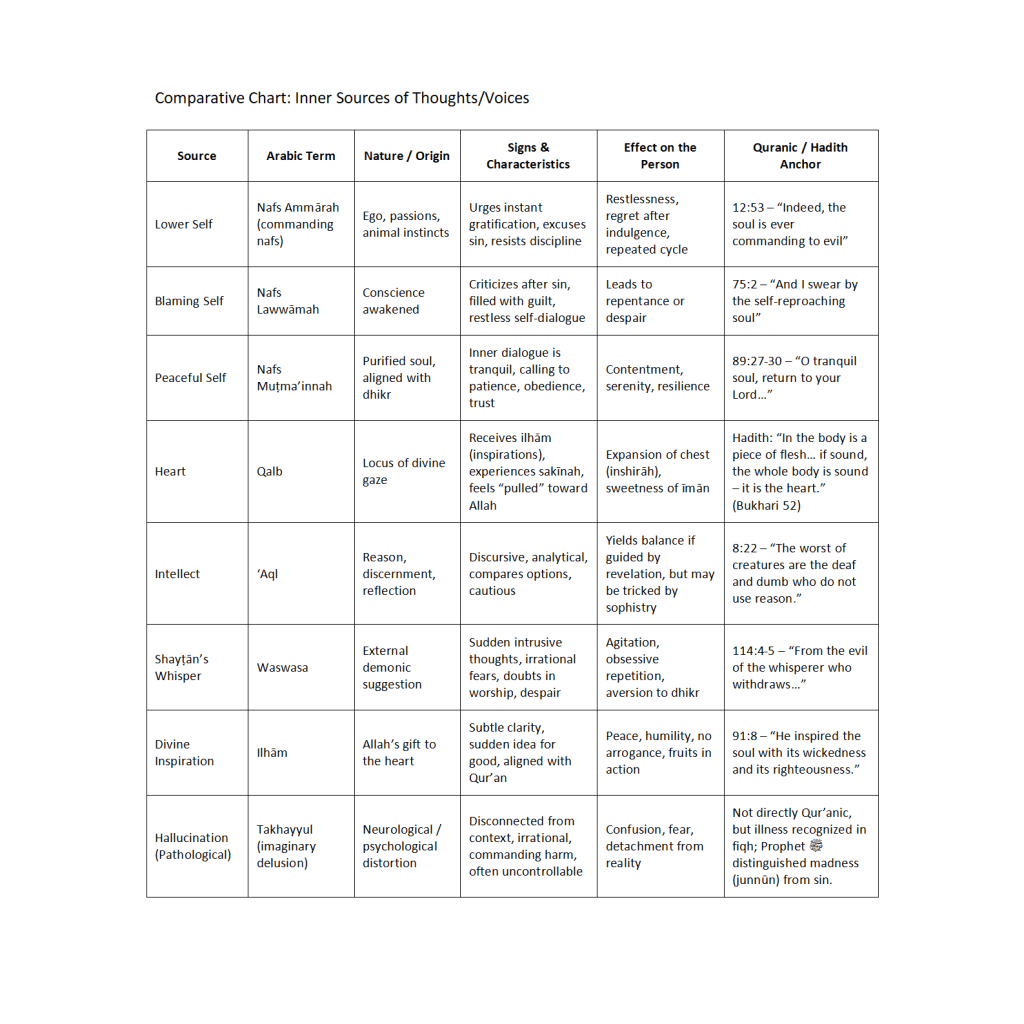
Key for Differentiation (Practical Discernment)
1. By Fruits: If it leads to obedience, humility, serenity → likely qalb or nafs muṭma’innah. If it leads to haste, pride, chaos → nafs ammārah or shayṭān.
2. By Resistance: Waswasa vanishes when ignored; ilham persists gently until acted upon.
3. By Light: The heart inspirations never contradict Qur’an and Sunnah. Hallucinations often distort, exaggerate, or command harm.
- By Accompaniment: Inner dialogue from the self feels “yours” Shayṭan whisper feels foreign, sharp, intrusive.
- Let us examine the situation with an example
Case Study 1: Youth in Prayer
Scenario: Ahmad begins his ṣalāh. Suddenly, a thought arises: “Did I wash properly in wuḍū’?” He repeats the Fātiḥah twice, then doubts again.
Analysis: The voice is sudden, intrusive, repetitive → sign of waswasa (shayṭan).
Effect: anxiety, compulsion, loss of khushu
Remedy: Ignore, recite audhu billah min al-shayṭan al-rajim, continue prayer.
Chart Alignment:
Source: Waswasa → brings agitation, never contentment.
Anchor: 114:4-5.
Case Study 2: Business Temptation
Scenario: Fatimah runs a shop. A bribe opportunity arises — quick profit, no one watching. Her mind whispers: “It’s just a small thing, others do worse.” Later that night, her heart feels heavy, regretful.
Analysis:
First voice: nafs ammārah (rationalizing sin).
Second voice: nafs lawwāmah (self-reproach).
If she resists and recalls Allah, she may ascend toward nafs muṭma’innah.
Chart Alignment:
First → nafs ammarah: excusing, instant gratification.
Second → nafs lawwamah: guilt, restlessness.
Fruit of acting rightly → peace (ṭuma’nīnah).
Anchor: 12:53, 75:2.
Case Study 3: Sudden Inspiration to Charity
Scenario: Yusuf, while walking, suddenly feels: “Give some money to that struggling worker.” The thought is gentle, persistent, not compulsive. He gives, and feels inner expansion.
Analysis:
This is not agitation but clarity.
No contradiction with sharī‘ah.
Accompanied by sweetness, humility.
Likely ilham (divine inspiration via qalb).
Chart Alignment:
Source: Qalb / ilham.
Anchor: 91:8.
Case Study 4: Psychiatric Hallucination vs. Waswasa
Scenario:
A man hears an audible voice commanding: “Hurt yourself. You are worthless.”
He cannot switch it off.
It comes even outside worship.
It disconnects him from reality, causes fear.
Analysis:
This is not mere waswasa.
Hallucination (takhayyul / jinnun) → needs medical and spiritual intervention together.
Difference: Waswasa is subtle suggestion, not commanding with auditory intensity.
Chart Alignment:
Source: Pathological hallucination.
Anchor: Prophet said: “The pen is lifted from the insane until he regains sanity.” (Abu Dawud 4401).
Case Study 5: Using the ‘Aql vs. Qalb
Scenario: Khalid receives two job offers: one higher-paying in a dubious environment, the other modest but halal. His intellect (aql) calculates: “The higher salary means security.” But his heart (qalb) feels unsettled: “The risk of sin will harm your akhirah.”
Analysis:
Aql by itself seeks worldly advantage.
Qalb illuminated by īmān discerns higher truth.
If he follows qalb, he will feel sakīnah.
Chart Alignment:
Aql → rational analysis, but may be blind without revelation.
Qalb → locus of sakinah.
Anchor: 13:28.
The path of discernment (furqān) requires observing the fruit of a thought: agitation or peace, arrogance or humility, despair or hope. The heart is the compass — but it must be polished by dhikr and Qur’an, otherwise it cannot reflect truth.
The Qur’an itself is called al-Furqān — the Criterion that separates truth from falsehood (25:1). But Allah also promises the believer:
“O you who believe! If you fear Allah, He will grant you a criterion (furqān), remove your sins, and forgive you.” (8:29)
This shows that furqan is not only a revealed Book but also a divine light gifted to the heart of the God-conscious, enabling them to distinguish between voices within themselves.
The nafs ammarah (commanding self) pushes toward indulgence, rationalizes sin, and seeks instant gratification. The nafs lawwamah (self-reproaching self) generates guilt and inner criticism, while the nafs muṭmaʾinnah (tranquil self) whispers peace and contentment aligned with obedience to Allah. The qalb is the locus of divine gaze; when sound, it receives inspirations (ilham) that bring serenity, humility, and clarity.
The aql provides rational analysis and comparison, useful but limited without revelation.
Waswasa, in contrast, are intrusive, repetitive whispers from Shayṭan that agitate the believer and cast doubts.
Hallucinations, meanwhile, differ from all these: they are pathological states that overwhelm the mind, often commanding harm or breaking one’s grasp on reality, and require both medical and spiritual attention.
The distinguishing signs lie in their fruits: waswasa brings agitation, ilham brings serenity, nafs ammārah leads to regret, while nafs muṭmaʾinnah leads to resilience and peace. Inner dialogue from the self may fluctuate, but the heart’s inspirations never contradict the Qur’an and Sunnah. Thus, furqan functions as a spiritual intelligence — a divine gift of discernment that allows the believer to navigate inner voices without being lost in them.
To confuse hallucination with waswasa, or self-talk with divine ilhām, is dangerous.
Without furqan, the heart may drift in doubt, agitation, and existential emptiness. But with furqān, the believer learns to separate false whispers from true inspirations, egoic urges from spiritual guidance.
The path to this criterion is not intellectual sharpness alone, but taqwa: living in God-consciousness, cleansing the nafs, and keeping the heart alive with dhikr and Qur’an. In a world where many feel lost in inner noise and existential vacuums, the Qur’anic concept of furqan offers a timeless therapy — one that restores clarity, anchors identity in Allah, and leads the soul toward serenity.
 Unconventional Duha Research Unitary
Leave a comment