
The Epistemic Depths of Ruʾyah and Nazar – Two Modes of Quranic Observation
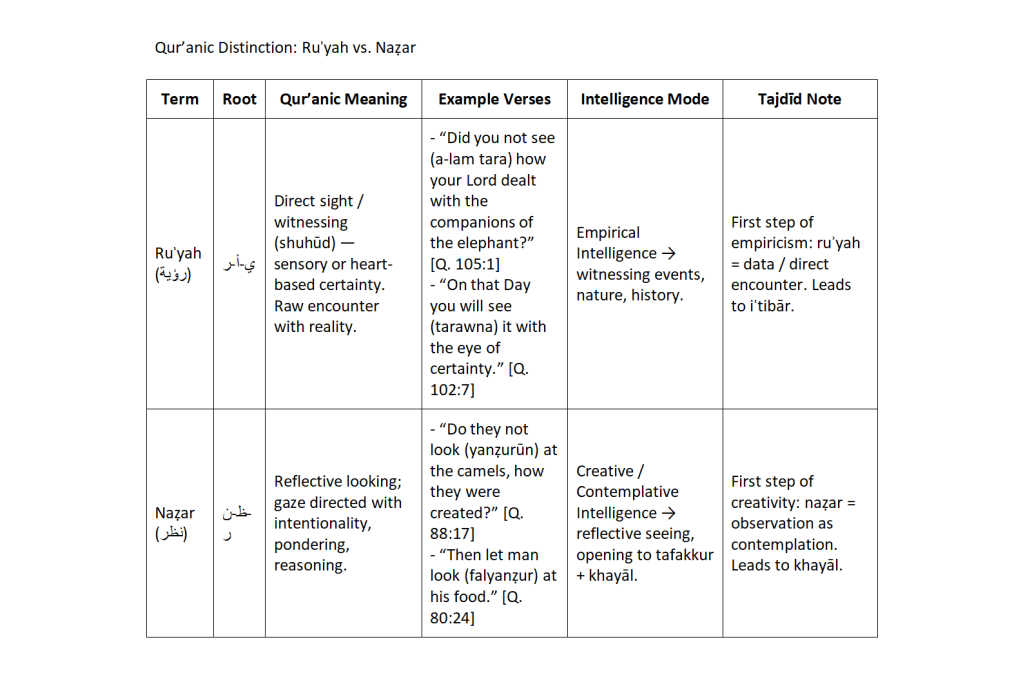
In the rich tapestry of Quranic Arabic, the distinction between ruʾyah (رؤية) and naẓar (نظر) reveals profound insights into the nature of human cognition and spiritual perception. While both terms can be superficially translated as “observation,” they represent fundamentally different epistemic approaches that form the foundation of what can be termed the “Mujaddid Model” of Islamic intellectual renewal. This essay explores these two complementary yet distinct modes of perception as they appear in the Quran, examining their roles in empirical and creative intelligence, and their significance for contemporary Islamic thought.
Ruʾyah: The Witnessing Eye
Etymological Foundation
Ruʾyah, derived from the trilateral root ر-أ-ي (ra-hamza-ya), encompasses the concept of direct sight and immediate perception. The Quran employs this term in contexts that emphasize witnessing and certainty, as exemplified in Surah Al-Fil: “Have you not seen ˹O Prophet˺ how your Lord dealt with the Army of the Elephant?”
(أَلَمْ تَرَ كَيْفَ فَعَلَ رَبُّكَ بِأَصْحَـٰبِ ٱلْفِيلِ)
This usage is particularly significant because the Prophet Muhammad (peace be upon him) did not literally witness the historical event of Abraha’s attack on Mecca, which occurred before his birth. Yet the Quran uses the term “tara” (you see), indicating that ruʾyah transcends mere physical sight to encompass a form of witnessing through transmitted knowledge that achieves the certainty of direct observation.
The Certainty of Witnessing
The most striking example of ruʾyah’s association with certainty appears in Surah At-Takathur: “Again, you will surely see it with the eye of certainty” (ثُمَّ لَتَرَوُنَّهَا عَيْنَ ٱلْيَقِينِ).
Here, the Quran explicitly links seeing (ruʾyah) with “the eye of certainty” (ʿayn al-yaqīn), establishing ruʾyah as a mode of perception that yields unshakeable conviction.
This concept of ruʾyah as shuhūd (witnessing) extends beyond the physical realm. The Quran describes how sincere believers respond to divine revelation: “When they listen to what has been revealed to the Messenger, you see their eyes overflowing with tears for recognizing the truth”
(وَإِذَا سَمِعُوا مَآ أُنزِلَ إِلَى ٱلرَّسُولِ تَرَىٰٓ أَعْيُنَهُمْ تَفِيضُ مِنَ ٱلدَّمْعِ مِمَّا عَرَفُوا مِنَ ٱلْحَقِّ).
This verse demonstrates how ruʾyah can manifest as an immediate, visceral recognition of truth that bypasses analytical reasoning.
The Limitations of Mere Sight
The Quran also warns against the limitations of physical sight divorced from spiritual insight. In Surah Al-A’raf, Allah describes those destined for Hell: “Indeed, We have destined many jinn and humans for Hell. They have hearts they do not understand with, eyes they do not see with, and ears they do not hear with (وَلَقَدْ ذَرَأْنَا لِجَهَنَّمَ كَثِيرًا مِّنَ ٱلْجِنِّ وَٱلْإِنسِ ۖ لَهُمْ قُلُوبٌ لَّا يَفْقَهُونَ بِهَا وَلَهُمْ أَعْيُنٌ لَّا يُبْصِرُونَ بِهَا وَلَهُمْ ءَاذَانٌ لَّا يَسْمَعُونَ بِهَآ).
This verse establishes that true ruʾyah requires more than functional eyesight; it demands spiritual receptivity and divine guidance.
Naẓar: The Contemplative Gaze
The Art of Reflective Observation
Naẓar, from the root ن-ظ-ر (nun-ẓa-ra), represents a fundamentally different mode of perception. While ruʾyah emphasizes immediate witnessing, naẓar involves deliberate, contemplative observation that leads to deeper understanding. The Quran consistently uses naẓar in contexts that invite reflection and analysis.
The paradigmatic example appears in Surah Aal-Imran, describing the believers who “remember Allah while standing, sitting, and lying on their sides, and reflect on the creation of the heavens and the earth”
(ٱلَّذِينَ يَذْكُرُونَ ٱللَّهَ قِيَـٰمًا وَقُعُودًا وَعَلَىٰ جُنُوبِهِمْ وَيَتَفَكَّرُونَ فِى خَلْقِ ٱلسَّمَـٰوَٰتِ وَٱلْأَرْضِ)
Here, the verb “yatafakkarūn” (they reflect) is closely associated with naẓar, indicating that true contemplation involves both looking and thinking.
Nazar as Invitation to Tafakkur
The Quran frequently employs naẓar as a precursor to tafakkur (reflection): “He ˹also˺ subjected for you whatever is in the heavens and whatever is on the earth—all by His grace. Surely in this are signs for people who reflect”
(وَسَخَّرَ لَكُم مَّا فِى ٱلسَّمَـٰوَٰتِ وَمَا فِى ٱلْأَرْضِ جَمِيعًا مِّنْهُ ۚ إِنَّ فِى ذَٰلِكَ لَـَٔايَـٰتٍۢ لِّقَوْمٍۢ يَتَفَكَّرُونَ).
This pattern appears repeatedly, establishing naẓar as the gateway to deeper contemplation.
Similarly, in Surah Yunus, after describing the metaphor of worldly life as temporary vegetation, the Quran concludes: “This is how We make the signs clear for people who reflect”
(كَذَٰلِكَ نُفَصِّلُ ٱلْـَٔايَـٰتِ لِقَوْمٍۢ يَتَفَكَّرُونَن).
The entire passage invites naẓar—careful observation of natural phenomena—as a means to understand deeper spiritual truths.
The Intentionality of Naẓar
A crucial aspect of naẓar is revealed in Surah Al-A’raf: “Perhaps your Lord will destroy your enemy and make you successors in the land to see what you will do”
(عَسَىٰ رَبُّكُمْ أَن يُهْلِكَ عَدُوَّكُمْ وَيَسْتَخْلِفَكُمْ فِى ٱلْأَرْضِ فَيَنظُرَ كَيْفَ تَعْمَلُونَ).
Here, Allah’s “looking” (yanẓur) is not passive observation but active evaluation—naẓar inherently involves judgment and assessment.
Epistemological Balance
The distinction between ruʾyah and naẓar offers contemporary Muslim intellectuals a sophisticated epistemological framework that avoids both naive empiricism and disconnected speculation. Ruʾyah ensures grounding in observable reality, while naẓar provides the contemplative depth necessary for creative synthesis and innovation.
Educational Applications
In Islamic education, this dual framework suggests the need for both experiential learning (ruʾyah-based) and reflective analysis (nazar-based). Students should be exposed to direct encounters with Islamic texts, history, and practices, while also being trained in contemplative reflection that can generate new insights and applications.
Scholarly Methodology
For Islamic scholarship, the ruʾyah-naẓar distinction provides a methodological foundation that honors both the empirical tradition of hadith criticism and historical analysis, and the contemplative tradition of tafsīr and spiritual reflection. Modern mujaddids (renewers) can employ both modes to address contemporary challenges while remaining rooted in authentic Islamic sources.
The Quranic distinction between ruʾyah and naẓar reveals a sophisticated understanding of human cognition that transcends simple dichotomies between reason and revelation, or empiricism and spirituality. Ruʾyah, as the mode of witnessing and immediate perception, provides the certainty and grounding necessary for authentic knowledge. Naẓar, as the mode of contemplative reflection, opens the pathways to creative insight and spiritual understanding.
Together, these two modes of observation form the foundation of what we might call a truly Islamic epistemology—one that honors both the immediacy of divine revelation and the human capacity for reflective understanding. For contemporary Muslims seeking to engage with modernity while maintaining authentic Islamic identity, the ruʾyah-naẓar framework offers a path that is neither reactionary nor accommodationist, but genuinely creative and renewing.
The Quran’s employment of these terms demonstrates that true Islamic intelligence is neither purely empirical nor purely rational, but symphonic—integrating multiple modes of perception and understanding in service of both worldly effectiveness and spiritual realization. In this integration lies the potential for authentic tajdīd (renewal) that can address the challenges of our time while remaining faithful to the eternal wisdom of Islamic revelation.
SubḥanAllah, this linguistic richness exemplifies why the Quran never confines thinking to a single term or approach, but rather multiplies the pathways of intelligence, showing that the luminous intellect operates not through linear progression but through symphonic integration of diverse modes of perception and understanding.
References:
[1] Quran 105:1:
Arabic: أَلَمْ تَرَ كَيْفَ فَعَلَ رَبُّكَ بِأَصْحَـٰبِ ٱلْفِيلِ
English: Have you not seen ˹O Prophet˺ how your Lord dealt with the Army of the Elephant?
[2] Quran 102:7:
Arabic: ثُمَّ لَتَرَوُنَّهَا عَيْنَ ٱلْيَقِينِ
English: Again, you will surely see it with the eye of certainty.
[3] Quran 5:83:
Arabic: وَإِذَا سَمِعُوا مَآ أُنزِلَ إِلَى ٱلرَّسُولِ تَرَىٰٓ أَعْيُنَهُمْ تَفِيضُ مِنَ ٱلدَّمْعِ مِمَّا عَرَفُوا مِنَ ٱلْحَقِّ ۖ يَقُولُونَ رَبَّنَآ ءَامَنَّا فَٱكْتُبْنَا مَعَ ٱلشَّـٰهِدِينَ
English: When they listen to what has been revealed to the Messenger, you see their eyes overflowing with tears for recognizing the truth.
[4] Quran 7:179:
Arabic: وَلَقَدْ ذَرَأْنَا لِجَهَنَّمَ كَثِيرًا مِّنَ ٱلْجِنِّ وَٱلْإِنسِ ۖ لَهُمْ قُلُوبٌ لَّا يَفْقَهُونَ بِهَا وَلَهُمْ أَعْيُنٌ لَّا يُبْصِرُونَ بِهَا وَلَهُمْ ءَاذَانٌ لَّا يَسْمَعُونَ بِهَآ ۚ أُولَـٰٓئِكَ كَٱلْأَنْعَـٰمِ بَلْ هُمْ أَضَلُّ ۚ أُولَـٰٓئِكَ هُمُ ٱلْغَـٰفِلُونَ
English: Indeed, We have destined many jinn and humans for Hell. They have hearts they do not understand with, eyes they do not see with, and ears they do not hear with.
[5] Quran 3:191:
Arabic: ٱلَّذِينَ يَذْكُرُونَ ٱللَّهَ قِيَـٰمًا وَقُعُودًا وَعَلَىٰ جُنُوبِهِمْ وَيَتَفَكَّرُونَ فِى خَلْقِ ٱلسَّمَـٰوَٰتِ وَٱلْأَرْضِ رَبَّنَا مَا خَلَقْتَ هَـٰذَا بَـٰطِلًا سُبْحَـٰنَكَ فَقِنَا عَذَابَ ٱلنَّارِ
English: ˹They are˺ those who remember Allah while standing, sitting, and lying on their sides, and reflect on the creation of the heavens and the earth ˹and pray˺, “Our Lord!
[6] Quran 45:13:
Arabic: وَسَخَّرَ لَكُم مَّا فِى ٱلسَّمَـٰوَٰتِ وَمَا فِى ٱلْأَرْضِ جَمِيعًا مِّنْهُ ۚ إِنَّ فِى ذَٰلِكَ لَـَٔايَـٰتٍۢ لِّقَوْمٍۢ يَتَفَكَّرُونَ
English: He ˹also˺ subjected for you whatever is in the heavens and whatever is on the earth—all by His grace. Surely in this are signs for people who reflect.
[7] Quran 10:24:
Arabic: إِنَّمَا مَثَلُ ٱلْحَيَوٰةِ ٱلدُّنْيَا كَمَآءٍ أَنزَلْنَـٰهُ مِنَ ٱلسَّمَآءِ فَٱخْتَلَطَ بِهِۦ نَبَاتُ ٱلْأَرْضِ مِمَّا يَأْكُلُ ٱلنَّاسُ وَٱلْأَنْعَـٰمُ حَتَّىٰٓ إِذَآ أَخَذَتِ ٱلْأَرْضُ زُخْرُفَهَا وَٱزَّيَّنَتْ وَظَنَّ أَهْلُهَآ أَنَّهُمْ قَـٰدِرُونَ عَلَيْهَآ أَتَىٰهَآ أَمْرُنَا لَيْلًا أَوْ نَهَارًا فَجَعَلْنَـٰهَا حَصِيدًا كَأَن لَّمْ تَغْنَ بِٱلْأَمْسِ ۚ كَذَٰلِكَ نُفَصِّلُ ٱلْـَٔايَـٰتِ لِقَوْمٍۢ يَتَفَكَّرُونَ
English: The life of this world is just like rain We send down from the sky, producing a mixture of plants which humans and animals consume. Then just as the earth looks its best, perfectly beautified, and its people think they have full control over it, there comes to it Our command by night or by day, so We mow it down as if it never flourished yesterday! This is how We make the signs clear for people who reflect.
[8] Quran 7:129:
Arabic: قَالُوٓا أُوذِينَا مِن قَبْلِ أَن تَأْتِيَنَا وَمِنۢ بَعْدِ مَا جِئْتَنَا ۚ قَالَ عَسَىٰ رَبُّكُمْ أَن يُهْلِكَ عَدُوَّكُمْ وَيَسْتَخْلِفَكُمْ فِى ٱلْأَرْضِ فَيَنظُرَ كَيْفَ تَعْمَلُونَ
English: They complained, “We have always been oppressed—before and after you came to us ˹with the message˺.” He replied, “Perhaps your Lord will destroy your enemy and make you successors in the land to see what you will do.”
[9] Quran 14:45:
Arabic: وَسَكَنتُمْ فِى مَسَـٰكِنِ ٱلَّذِينَ ظَلَمُوٓا أَنفُسَهُمْ وَتَبَيَّنَ لَكُمْ كَيْفَ فَعَلْنَا بِهِمْ وَضَرَبْنَا لَكُمُ ٱلْأَمْثَالَ
English: You passed by the ruins of those ˹destroyed peoples˺ who had wronged themselves. It was made clear to you how We dealt with them, and We gave you ˹many˺ examples.
[10] Quran 16:11:
Arabic: يُنۢبِتُ لَكُم بِهِ ٱلزَّرْعَ وَٱلزَّيْتُونَ وَٱلنَّخِيلَ وَٱلْأَعْنَـٰبَ وَمِن كُلِّ ٱلثَّمَرَٰتِ ۗ إِنَّ فِى ذَٰلِكَ لَـَٔايَةً لِّقَوْمٍۢ يَتَفَكَّرُونَ
English: With it He produces for you ˹various˺ crops, olives, palm trees, grapevines, and every type of fruit. Surely in this is a sign for those who reflect.
 Unconventional Duha Research Unitary
Leave a comment